Doing good work is important, no matter the industry. Steel construction is no exception. In this work, accurate measurements, proper fabrication, and efficient installation are all vital to the success of a project.
But doing good work does not mean simply finding a process that works and repeating it forever. It means continually looking for ways to improve.
At MMI Industrial & Steel, one of our core values is Hungry. To us, being Hungry means constant improvement—even when the current approach is already getting the job done. It means asking questions, learning from each project, and refusing to assume that the way something has “always been done” is automatically the best way to do it next time.
In steel construction, that mindset can make an enormous difference.
Every Project Has Something to Teach Us
No two steel projects are exactly alike.
Some are clearly large and complex from the beginning. Others appear relatively straightforward until the team gets into the details. As Nathan Brown recently pointed out in an MMI project recap, the difficulty of a job is not necessarily related to its size.
A recent Scottsdale renovation was the perfect example.
MMI was contracted to install above-ceiling steel for new operable walls in an existing office building. The amount of steel itself was relatively small, but the logistical challenges were significant.
The building remained fully occupied throughout construction. This meant:
- Limited space for staging materials
- Minimal parking for service vehicles
- A 2-hour window for deliveries each day (all deliveries had to happen between 5-7 a.m.)
- Strict noise restrictions after 7 a.m.
- A need to protect surrounding businesses, as complaints from adjacent occupants could halt or delay work
A project like that requires more than simply knowing how to fabricate and erect steel.
It requires curiosity, creativity, and flexibility.
Keep Asking How the Work Can Be Better
A Hungry mindset encourages teams to look beyond the obvious solution.
On the Scottsdale project, steel could only enter the building through one specific location. From there, it had to travel through what Nathan described as a “maze of walls and corridors” before reaching the installation area.
Rather than waiting until installation day to discover whether the route would work, the field team walked the path multiple times. They coordinated with the general contractor and other trades to identify obstacles, remove them where necessary, and develop a workable route through existing steel studs and finished walls.
The question was not simply, “Can we get this steel into place?”
It became, “What is the safest, smartest, and most efficient way to get it there?”
That shift in mindset, along with targeted preparation, reflects continuous improvement at a very practical level.
Improvement Happens Across the Entire Team
When you focus on continuous improvement, you recognize that no part of a steel project happens in isolation.
Field planning matters. So does detailing, fabrication, coordination between teams.
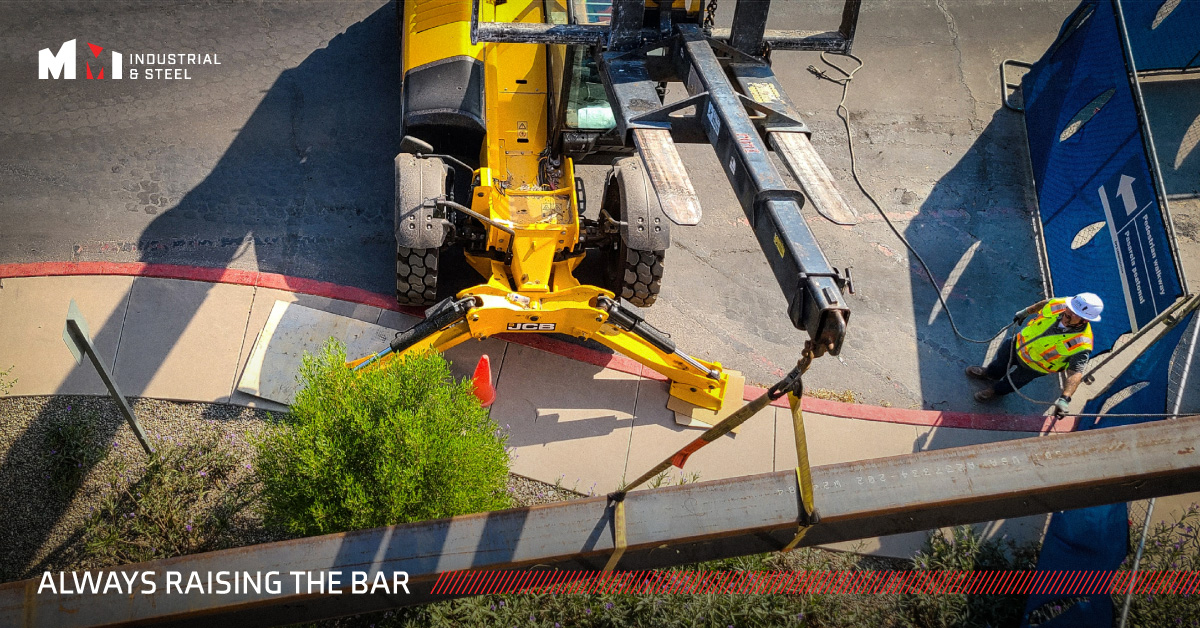
Installation for the Scottsdale project required moving approximately 2,700 pounds of steel through the building. The MMI crew rigged the steel onto carts at a third-floor patio and moved 32-foot beams roughly 350 feet through rooms, corridors, and openings cut into existing walls.
Nathan credited field-verified dimensions, accurate detailing, and precision during shop fabrication with allowing the steel to move into place and bolt up without issues. The remaining support steel and bracing were installed over the following days, and the project was completed on schedule.
Continuous improvement isn’t the responsibility of one person. It happens across the organization.
Each team has an opportunity to make the next team more successful.
Refusing to Settle for “Good Enough”
Steel construction is no easy task, and it would be easy to define success as simply completing the work.
A Hungry team looks a little further.
- Could planning have been stronger?
- Could communication have been clearer?
- Could fabrication have been more efficient?
- What worked especially well that should be repeated on the next project?
Those questions are valuable—whether a project goes smoothly or presents challenges along the way.
In fact, the Scottsdale project is already proving this point. MMI recently completed the first phase and is preparing to return for phase two, with the goal of replicating what worked successfully the first time.
Continuous improvement does not mean reinventing everything every time. Sometimes it means recognizing what worked, understanding why it worked, and carrying those lessons forward.
Hungry Today, Better Tomorrow
You can’t be complacent in steel construction.
Projects change. Conditions change. Customer needs change. Even two projects with similar finished products may require very different paths to get there successfully.
That’s why being Hungry matters.
It keeps us curious. It pushes us to learn from experience, share better ideas, improve our processes, and raise the standard for the work that comes next.
At MMI Industrial & Steel, the goal is not simply to keep building.
It is to keep getting better.